Bom Bhole is a kirtan—a devotional chant—that invokes Shiva through the Sanskrit phrase "Bom Bhole," a salutation traditionally associated with Shaivite worship. The song pairs traditional call-and-response sacred singing with contemporary live instrumentation: acoustic guitar, keys, harmonium, drums, and bass. Filmed in Mauritius, this official music video showcases a pluralistic approach to spiritual music-making, performed by musicians from diverse backgrounds who see kirtan as a universal practice rather than a culturally exclusive form. The track arrives as part of a new album release and precedes an extensive European tour.
What Is Bom Bhole and Why Sing It?
"Bom Bhole" is a sacred chant that honors Shiva, one of the principal deities in Hindu philosophy. The phrase itself—"Bom" (also spelled "Aum" or "Om") combined with "Bhole" (meaning innocent, pure, or simple-hearted)—is a traditional salutation used in Shaivite devotion. However, in the context of kirtan as Sam Garrett practices it, the chant is not presented as exclusively Hindu religious practice but rather as a universal form of participatory devotional singing.
Kirtan involves a call-and-response structure where a lead vocalist sings a melody and lyrics (often in Sanskrit), and participants repeat or join in. This ancient form of devotional music has roots in Indian classical traditions but, when practiced in contemporary global contexts, often functions as a meditation tool and heart-opening practice accessible to people of any or no religious background. Sam Garrett's approach, reflected in his statement that he is "a Human Being, no more or less than anyone else," positions kirtan as a practice of shared humanity rather than cultural appropriation or exclusive religious performance.
How Does This Kirtan Blend Traditional and Contemporary Elements?
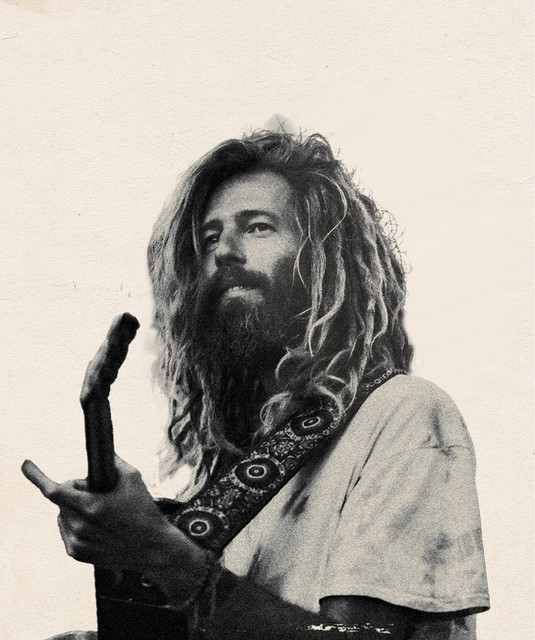
The musical arrangement of "Bom Bhole" demonstrates a deliberate fusion of traditional and modern instrumentation. The core setup includes acoustic guitar (played by Sam Garrett), harmonium (a hand pump organ central to Indian devotional music), and a full rhythm section of drums and bass. Keys add harmonic depth and contemporary production values. This combination honors the essence of kirtan—the repetitive, meditative melodic line anchored by harmonium—while integrating elements of world music production and live-band energy.
The presence of backing vocals and harmonium performed by Jemma Endersby, alongside a multicultural ensemble (Calvin Bennion on keys, Alex Hoeffken on drums, Armin Metz on bass), creates a genuine ensemble experience. Rather than a recording by a single artist with studio musicians, "Bom Bhole" presents itself as a living, collaborative musical practice. The video was filmed on location in Mauritius, a geographically and culturally diverse island nation, which itself reinforces the message that this sacred music transcends geographic and cultural boundaries.
What Does the Music Video Communicate About Spirituality?
The visual presentation of "Bom Bhole" as an official music video—shot by multiple cinematography teams (Chenel videography, Karan Jeebun studio, Mazzika) and professionally edited—reflects a contemporary approach to sacred music distribution. Rather than remaining confined to ashrams, yoga studios, or niche kirtan communities, the song is presented as a mainstream music release with an album launch and international tour.
This positioning matters. By releasing kirtan as a professional music video with tour dates across Europe, Garrett signals that devotional practice is not separate from modern cultural life but can be integrated into it. The tour schedule—spanning November and December 2024 through May 2025 across cities including Berlin, London, Amsterdam, Paris, and Lisbon—demonstrates demand for this form of sacred music in secular concert venues. Attendees are not necessarily yoga practitioners or Hindu devotees; they may simply be people drawn to participatory singing, meditative music, or the communal experience of chanting together.
Why Does Sam Garrett Emphasize Being "a Human Being"?
In his description, Garrett explicitly states: "I am not a Hindu, nor a Rasta, nor a guru, I am a Human Being, no more or less than anyone else." This statement addresses a common concern about cultural authenticity and spiritual appropriation in global kirtan practice. By refusing to claim religious or hierarchical authority—he does not position himself as a guru or spiritual teacher—Garrett frames his work as humble musical expression rather than religious proselytizing.
This stance reflects a growing trend in contemporary kirtan where non-Indian musicians and non-Hindu practitioners have adopted the form. Rather than pretending to be something they are not, many modern kirtan artists acknowledge their backgrounds while honoring the tradition's roots. Garrett's humility suggests that the power of kirtan lies not in the performer's cultural identity or spiritual status but in the collective experience of singing together—the vibration, the breath, the community, and the intention brought to the practice by all participants.
What Is the Role of Call-and-Response in This Kind of Chanting?
The call-and-response structure of kirtan creates a specific form of participation. The lead singer (in this case, Garrett with acoustic guitar and vocals) establishes a melodic phrase or mantra. The community or backing vocalists repeat it, often with variation or extension. Over several minutes, the chant typically builds in energy and tempo, with repetition creating a hypnotic, meditative state.
This participatory structure is intentional: it prevents passive listening. Even someone unfamiliar with Sanskrit can join a kirtan by listening and repeating simple phrases. The repetition trains the mind to focus on sound and breath rather than narrative thought. For practitioners, this focus is understood as a gateway to states of deeper awareness or emotional release. The physical act of singing—engaging the diaphragm, vocal cords, and respiratory system—generates sensation in the body. Over time, participants report experiences ranging from mild relaxation to profound states of connection or transcendence.
How Does "Bom Bhole" Fit Into a Broader Album Release?
The official music video for "Bom Bhole" arrives as a prelude to a full album release on October 1st. This strategic rollout—single video followed by album launch—mirrors contemporary music industry practices. However, in the context of kirtan and spiritual music, the album release carries additional weight. Rather than being merely a collection of songs, a kirtan album functions as a resource for personal and group practice. Listeners can return to it repeatedly, using it as a meditation or study tool, not just passive entertainment.
The ensemble credited on the album—including Keith Tsukamaki on keys, Sam Ites on drums, and Sam Killeen on electric guitar for the recorded version—expands the vision of "Bom Bhole" across multiple iterations: a live touring band version and a studio recording version. This allows the song to exist in multiple forms suited to different contexts: intimate bedroom listening, yoga class background music, concert hall performance, or group kirtan sessions.
Where to Go From Here
If you are curious about kirtan as a practice, "Bom Bhole" and Sam Garrett's album offer an accessible entry point. You can listen to the song, explore the meaning of "Bom Bhole" as a Shaivite salutation, and then decide whether attending a live kirtan session or concert interests you. Garrett's European tour provides the opportunity to experience the song in a participatory setting—not as a spectator at a concert, but as a potential co-creator of the collective singing experience.
Beyond this single song, you might investigate the broader world of contemporary kirtan artists and communities in your area. Many cities now host weekly kirtan gatherings, often in yoga studios, music venues, or community spaces. These sessions are typically free or donation-based, require no prior experience, and welcome people from all backgrounds. The practice offers a low-barrier way to explore chanting, meditation, community, and devotional music without committing to any belief system or ideology.
Finally, consider what draws you to sacred music or participatory singing. Is it the meditative quality? The community aspect? The beauty of the melody or the meaning of the words? Understanding your own motivation can deepen your engagement with forms like kirtan and help you find teachers, communities, and practices that align with your genuine interests.